SOLUTIONS · TECHNOLOGY ANALYSIS
The most interesting part of Honeywell’s acquisition of Johnson Matthey’s Catalyst Technologies business may be the connection between two technologies already being selected together by fuel developers.
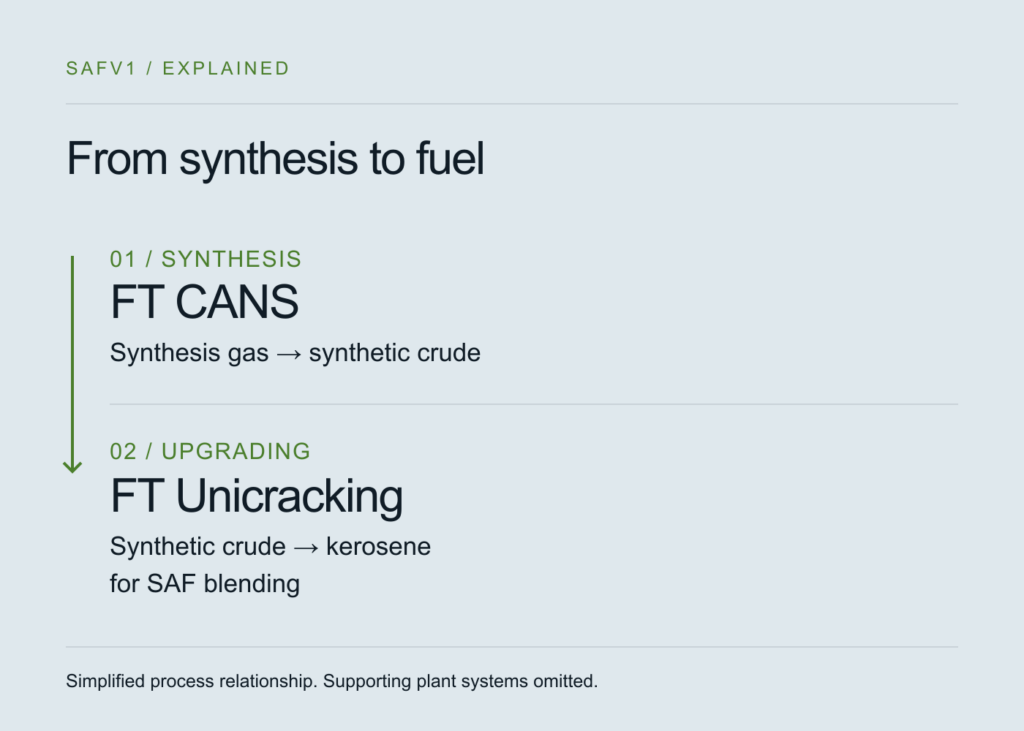
FT CANS turns synthesis gas into synthetic hydrocarbons. Honeywell UOP’s FT Unicracking takes the process further towards aviation fuel. For a developer trying to assemble a workable production chain, that relationship deserves attention.
Honeywell completed the acquisition on 17 July 2026 for £1.325 billion. Its stated rationale includes combining catalyst and process expertise with its existing automation and digital capabilities. Honeywell’s completion announcement
Two complementary jobs
FT CANS, developed by Johnson Matthey and bp, is a Fischer–Tropsch technology. It converts synthesis gas, a mixture of carbon monoxide and hydrogen, into synthetic hydrocarbons that require further processing to become finished fuels.
CANS is more than a catalyst formulation. JM describes modular catalyst containers that alter how reactants flow through the reactor. The design is intended to improve mass transfer and reaction performance while keeping pressure losses low, supporting smaller equipment and reduced catalyst requirements. These are the technology provider’s stated advantages, rather than a guarantee for every plant. JM’s CANS description
Honeywell’s FT Unicracking provides the downstream upgrading step. Honeywell now explicitly markets FT CANS and FT Unicracking together as a route from biomass- or waste-derived synthesis gas through synthetic crude to aviation and other fuels. Honeywell’s combined portfolio
The distinction matters: fuel synthesis and fuel upgrading solve different parts of the same production problem. A successful project has to make those parts work together.
A fit recognised before the acquisition
The technical relationship predates the change in ownership. In November 2024, JM and Honeywell UOP announced a memorandum of understanding to combine their capabilities for alternative-fuel projects using Fischer–Tropsch or methanol routes. Lower operating costs and faster deployment were stated objectives. The partnership announcement
There is also evidence of customer selection. In February 2026, Carbon Neutral Fuels announced that Project Starling in Workington would use JM and bp’s FT CANS alongside Honeywell UOP’s FT Unicracking. The announcement described synthetic crude from FT CANS being upgraded into synthetic kerosene suitable for SAF blending. Construction was planned for 2028, with production targeted for 2031. Project Starling announcement
That is evidence of a developer choosing the combination. It is not an operating record, and the acquisition did not create the pairing.
Where the opportunity lies
Our assessment is that bringing these capabilities into closer organisational alignment could make the interface between synthesis and upgrading easier for customers to manage. The practical questions include how the units are designed together, how performance responsibilities are allocated and how technical support responds when one part of the plant affects another.
Common ownership alone does not answer those questions. Nor does it supply a project’s feedstock, electricity, hydrogen, permits or finance. But a more coordinated technology offering could help developers address one important part of the delivery challenge.
The transaction’s history also argues for a measured verdict. Its original £1.8 billion valuation was reduced to £1.325 billion after deferred licensing projects and weaker catalyst profitability. JM disclosed those factors in February 2026. JM’s transaction update
There is a positive Solutions story here: complementary technologies, an established working relationship and named customers selecting both. The next test is whether that fit translates into dependable commissioning, operating performance and qualifying fuel delivered.
The acquisition has brought the capabilities together. The strongest measure of success will be what customers can achieve with them.
Reporting note: This analysis draws on the linked company disclosures and technology descriptions. Potential integration benefits are editorial assessments; project selections and production targets are not presented as completed operating results.
SAFV1 Monthly
The industrial reality, the foundations explained and verified developments worth following. Free, once a month. Confirm by email and unsubscribe at any time. Edition archive.