INDUSTRY ANALYSIS
In Rotterdam, two decisions in 2025 captured the central tension in sustainable aviation fuel.
On 9 April, Neste announced that SAF production had begun at its existing renewable products refinery. Modifications gave the site the capability to produce up to 500,000 tonnes of SAF a year.
Less than five months later, Shell said it would not restart construction of its separate Rotterdam biofuels facility. Work had begun in 2022. After reviewing the project’s commercial and technical position, Shell concluded that market conditions and the cost of completion made it insufficiently competitive.
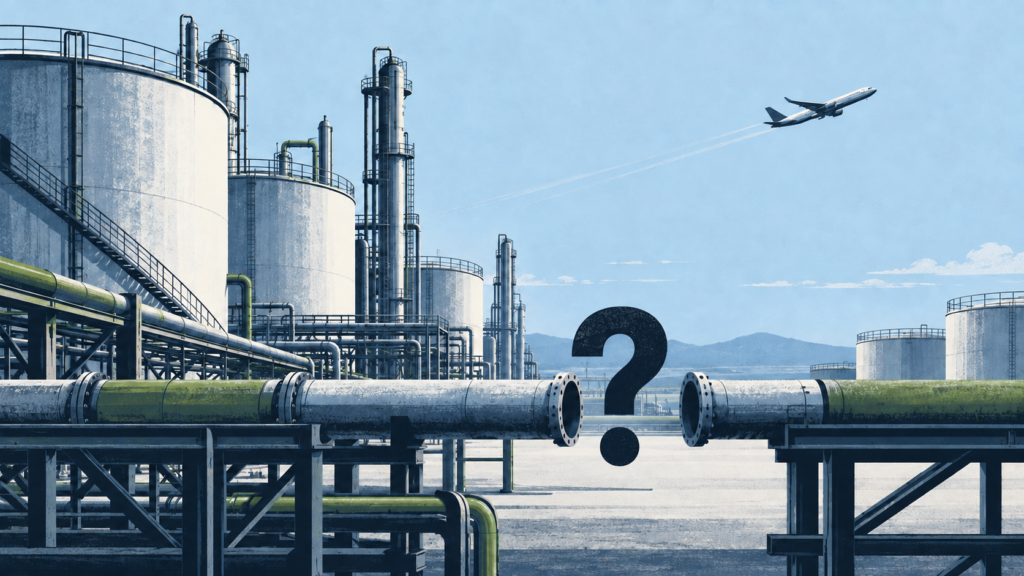
One city, a shared European policy framework, sharply different investment outcomes. The projects were different, so their fortunes cannot be reduced to a single cause. Their divergence nevertheless exposes the question behind every SAF capacity announcement: what will it take for this particular investment to deliver fuel?
The scale of the gap
The International Air Transport Association’s June 2026 outlook put expected global SAF production at around 2.4 million tonnes for the year, equivalent to 0.8% of aviation fuel use. That is a forecast, rather than a completed-year production total. It is also an industry association’s estimate, with IATA representing the airlines buying the fuel.
The figure gives a sense of how much expansion remains. It also makes the distinction between capacity and supply consequential. A refinery’s advertised annual capability describes what it could produce under specified conditions. It does not establish how much SAF it has made, sold or delivered during a particular year.
Neste’s 500,000-tonne Rotterdam figure should be read on that basis. The important demonstrated milestone in its April announcement was the start of production. The annual capability was a separate measure.
A demand signal still has to become a viable project
Europe has already moved beyond voluntary aspirations. ReFuelEU Aviation sets a minimum SAF share for fuel supplied at covered EU airports, beginning at 2% in 2025 and rising to 6% in 2030. Those are requirements on fuel suppliers; they are not a guarantee that any individual plant will be financed or completed.
Shell’s decision illustrates that distinction. The company’s stated explanation centred on competitiveness and completion costs. It also said it continued to see a role for low-carbon fuels and remained active in their supply. Abandoning one production investment did not amount to abandoning the market.
For readers assessing the next project, the useful questions therefore extend beyond whether demand exists. What revenue is contracted? Which construction and operating risks remain? How sensitive is the project to feedstock prices, energy costs and the policy support on which its economics depend?
The International Energy Agency’s 2025 sustainable fuels assessment identifies predictable demand, accessible financing and integrated supply chains among the priorities for deployment. Taken together, these point to an industrial coordination problem: a market can want more fuel while particular investments still struggle to proceed.
The distance between an opening and an operating record
Across the Atlantic, LanzaJet offers a different view of the delivery challenge.
The company held the grand opening of Freedom Pines Fuels in Soperton, Georgia, in January 2024. Its published project chronology explains that the ceremony took place before hydrocarbons were introduced, allowing a safe gathering on site. Mechanical completion followed in May, then commissioning. Hurricane Helene subsequently interrupted local utilities and delayed start-up work.
On 13 November 2025, LanzaJet announced full plant operation and production of jet fuel meeting ASTM specifications from ethanol at the commercial-scale facility.
That was a substantive technical milestone. It also demonstrates why the dates attached to a project matter. A ceremonial opening, mechanical completion, first fuel and sustained commercial production answer different questions. The November announcement established a production milestone; it did not, by itself, establish a full year of output at the plant’s rated capacity.
The next pathways raise the stakes
The delivery challenge becomes more demanding as the sector develops additional production routes. The IEA describes alcohol-to-jet, gasification-based biofuels and hydrogen-based synthetic fuels as being in the early stages of commercialisation. Their progress matters because they can broaden the resources available for fuel production.
In June 2026, IATA reported around 0.02 million tonnes of global e-SAF capacity operating or under construction, against the roughly 0.6 million tonnes it associated with EU and UK requirements in 2030. These are IATA’s dated estimates of different measures: installed or developing capacity and a future mandated volume. They indicate the scale of the construction task, rather than proving a precise future shortage.
Policy design is contested. IATA argues that production incentives and enabling infrastructure should precede mandates. The European framework uses binding demand requirements to support market development. The practical test is whether those signals translate into investable projects and reliable operations.
What to watch next
The evidence suggests that SAF’s progress is best assessed through a sequence of measurable steps: investment decisions, financed construction, commissioning, fuel meeting the required specifications, and disclosed commercial volumes.
Each step removes uncertainty. None makes the following step automatic. Reported volumes also need a clear label: SAF alone or a wider renewable-fuels total; production or sales; actual performance or annual design capability.
Environmental performance needs the same discipline. As the IEA emphasises, lifecycle emissions reductions depend on choices across the supply chain. A production milestone and a verified climate benefit are separate pieces of evidence, both necessary to assess the result.
Rotterdam’s contrasting projects and Georgia’s start-up sequence make the same broader point. The transition is being decided in individual investments and operating systems, under particular technical and commercial conditions. The next revealing number will be the volume of qualifying fuel those systems repeatedly deliver.
Source note: This analysis draws on the linked company disclosures, IATA estimates, IEA analysis and EU policy documents reviewed on 17 September 2026. Company milestones are attributed to their issuers. It does not incorporate original interviews or independently audited plant operating data.
SAFV1 Monthly
The industrial reality, the foundations explained and verified developments worth following. Free, once a month. Confirm by email and unsubscribe at any time. Edition archive.