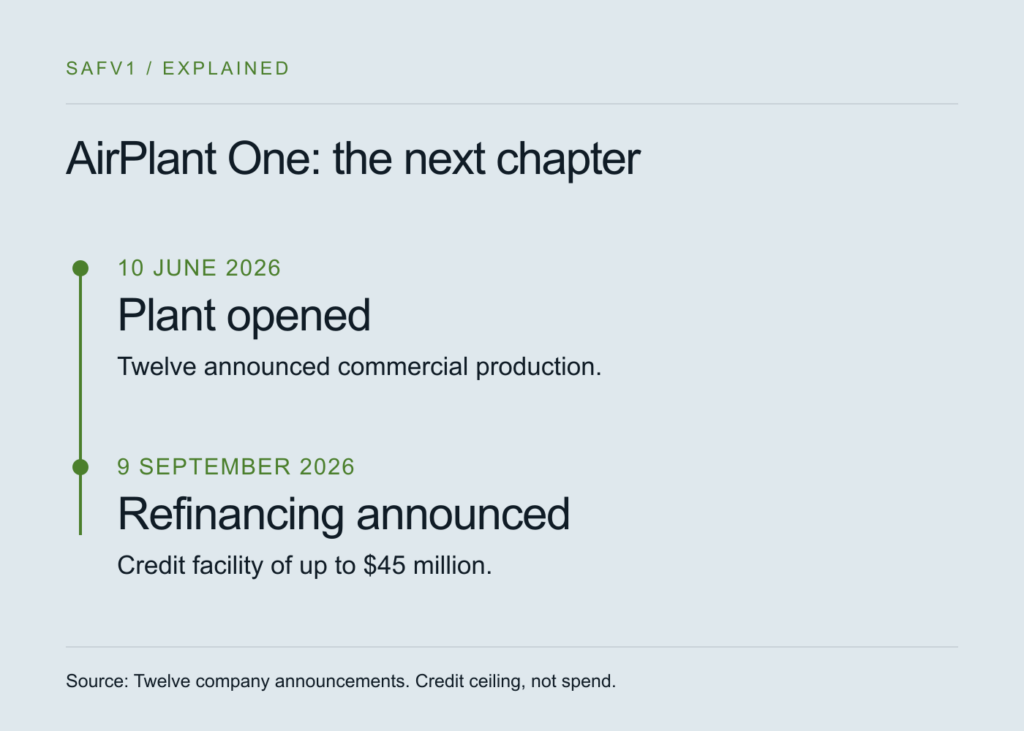
At Moses Lake in Washington, the SAF story has moved into the plant. Twelve opened AirPlant One on 10 June 2026, announcing commercial production of its E-Jet sustainable aviation fuel and E-Naphtha from carbon dioxide, water and renewable electricity. The opening is documented in the company’s June announcement.
For a sector working to turn technology into dependable supply, that is a milestone worth examining. An operating facility creates the opportunity to learn what a development plan cannot yet demonstrate: how equipment performs together, how consistently it runs and what it takes to improve.
A financing milestone after the opening
On 9 September, Twelve announced a credit facility of up to $45 million, led by Endurance Capital, with Nomura as joint bookrunner and administrative agent. The company says it refinanced the plant’s construction facility and includes an upsize option supporting expansion, including additional hydrogen production capacity. In the same financing announcement, chief executive Nicholas Flanders described AirPlant One as operating and producing aviation fuel and naphtha to specification.
The amount is a credit ceiling, not evidence that $45 million has all been drawn or spent on new equipment. Refinancing also replaces existing funding. Even with those distinctions, arranging finance for the next operating phase is a concrete step beyond the opening ceremony.
Keep the scale in view
Engineering firm Vista Projects describes AirPlant One as producing approximately 50,000 gallons a year of E-Jet SAF in its project account. That figure provides an indication of the facility’s stated annual scale; it should not be read as independently verified annual output. The sources reviewed do not establish a full year of production, utilisation or operating cost.
Vista also describes engineering and on-site support continuing through commissioning and start-up. That practical work matters: a fuel technology has to become an integrated facility, with utilities, controls, equipment and product handling working together.
At this scale, the strongest significance is the experience the plant can generate. Consistent operation, measured yields and maintenance records can help engineers improve the next installation and help capital providers assess its risks. Those benefits depend on the operating evidence that accumulates after start-up.
The next milestones are measurable
SAFV1’s view is that the next chapter should be judged through cumulative fuel output, dependable production, customer deliveries and the scope and timing of any completed expansion. These measures would show how the initial installation is becoming a repeatable industrial proposition.
There is a useful lesson here for the wider industry. Groundbreaking, mechanical completion, commissioning and sustained production each answer a different question. Recognising those stages makes progress more credible and gives everyone involved a clearer next task.
AirPlant One offers a positive example of movement through that sequence. The plant is open, Twelve reports fuel production, and financing has been arranged for its next phase. The opportunity now is to turn that start into a longer operating record and use it to build what comes next.
SAFV1 Monthly
The industrial reality, the foundations explained and verified developments worth following. Free, once a month. Confirm by email and unsubscribe at any time. Edition archive.